Most holiday rental properties look the same. Beige sofa, generic prints on the walls, a dining table that seats four. Guests scroll past them in seconds.
The properties that get booked consistently are the ones that look like someone actually thought about the guest. Not expensive, not designed by an architect. Just intentional. This guide covers how to furnish a holiday rental property so it stands out in search results, earns better reviews, and keeps the calendar full.
Why furnishing decisions directly affect bookings
Guests decide whether to book a holiday rental based almost entirely on photos. They cannot touch the mattress, test the shower pressure, or check if the sofa is comfortable. All they have is what the listing looks like.
That means furnishing choices do two jobs: they create the actual guest experience, and they create the first impression that convinces someone to book. A well-furnished property also earns better reviews. Guests who feel the property was thoughtfully put together tend to be more forgiving of minor issues and more likely to leave five stars.
Start here: know who you are furnishing for
Before buying a single piece of furniture, decide who your guest is. Furnishing a beach cottage for families with young children is a completely different brief from furnishing a city apartment for business travellers or a rural retreat for couples.
Ask yourself:
- How many guests will typically stay?
- Are they likely to cook properly or just make breakfast?
- Will they spend most time indoors or outdoors?
- Are they bringing children, pets, or expensive luggage?
The answers change almost every decision: the durability of fabrics, the number of dining seats, whether you need blackout blinds, how much kitchen kit to include. Furnishing without a clear guest profile produces a generic property that appeals to no one in particular.
How to furnish each room of a holiday rental property
Living room: the room that sells the booking
The living room is the hero shot of your listing. It needs to read well in a single photo and feel genuinely comfortable in person.
Sofa: Buy the best sofa you can afford. Guests notice cheap sofas immediately. Go for a fabric that cleans easily (boucle, performance velvet, or a tight weave) in a neutral tone that photographs well. Avoid white. A large corner sofa or a sofa-and-armchair combination gives guests flexibility and looks generous in photos.
Layout: Arrange furniture for conversation, not just for watching TV. A coffee table within reach of every seat, a lamp or two beyond the ceiling light, and at least one piece of furniture with visual weight (a bookcase, a console, a rug with pattern) lifts the space from functional to memorable.
Lighting: This is the most underused tool in holiday rental furnishing. Overhead lighting alone makes spaces look flat and unwelcoming in photos. Add floor lamps, table lamps, and if possible some warm LED strip lighting under shelves or behind the TV. Guests will use them, and they will photograph beautifully.
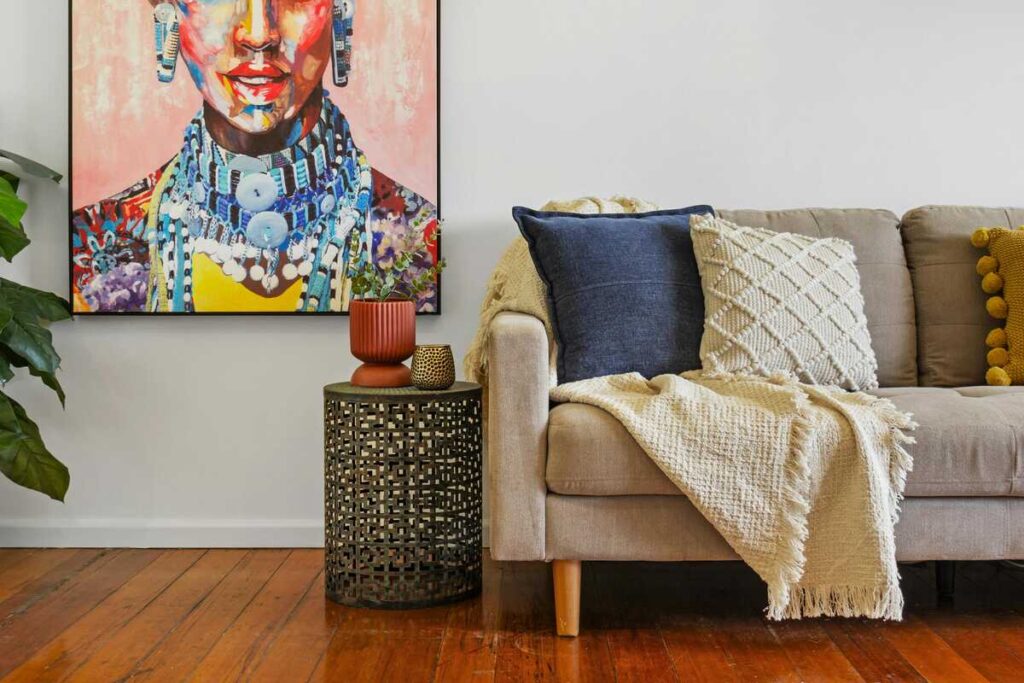
One distinctive piece: Every living room in a well-booked holiday rental has at least one thing guests photograph. A bold rug, an unusual armchair, a gallery wall done properly, a large indoor plant. It does not need to be expensive. It needs to be intentional.
Bedroom: where reviews are won or lost
Guests sleep in your property. How well they sleep is directly tied to whether they leave a good review.
Mattress: This is non-negotiable. Buy a good one. A medium-firm mattress suits most guests. If you are furnishing a double room, go for a king if the room allows it. Guests searching for a romantic break almost always filter by room size.
Bedding: Hotel-quality white cotton duvet covers read as clean and fresh in photos and in person. Have at least two full sets per bed so you can turn the property around quickly between stays. Add a throw at the foot of the bed. It costs nothing and looks intentional in photos.
Blackout blinds or curtains: Non-negotiable for any room used by guests who may be on different time zones, or travelling with children. Mention them explicitly in your listing. Guests search for them.
Storage: Guests on longer stays need to unpack. A wardrobe with proper hangers (not wire ones), a chest of drawers, and a luggage rack all signal a property that has thought about the guest experience. They also appear in photos and show the room has depth.
Bedside tables and lamps: One on each side of a double bed. With a plug socket within reach. This is one of the most common complaints in holiday rental reviews.
Kitchen: functional beats stylish here
Guests judge the kitchen on whether it has what they need to cook a proper meal. A beautiful kitchen with no sharp knives and a single pan gets worse reviews than a simple kitchen that is fully equipped.
The essentials: A full set of plates, bowls, and glasses for the maximum occupancy of the property plus two. Sharp knives. A decent chopping board. At least two pans (one large, one small), a frying pan, and a baking tray. A colander. A tin opener. Salt, pepper, and basic oil already in the cupboard.
The differentiators: A good coffee machine (not a capsule machine if you can avoid it), a blender, a toaster that fits more than two slices. These small additions get mentioned in reviews more than you would expect.
Durability: Buy crockery and glasses that you can replace easily when they break (and they will break). Avoid anything irreplaceable or sentimental.
Bathroom: clean surfaces and good towels
The bathroom does not need to be luxurious, but it needs to feel clean at first glance. That means clear surfaces, no visible cleaning products, and enough towel hooks and rails that guests do not leave wet towels on the floor.
Towels: White, hotel-weight, one bath towel and one hand towel per guest. Have two sets per person so you can launder between stays. Rolled or folded neatly on arrival, they photograph well and signal quality.
The basics guests always mention in reviews: A good shower with adequate pressure, enough mirror space, a hook on the back of the door, a proper toilet brush that is not revolting, and a spare toilet roll visible in the room (not hidden under the sink).
A small touch that costs almost nothing: A soap dispenser and a hand cream on the sink rather than a bar of soap in a dish. Guests notice this. It reads as thoughtful.
The furnishing details that separate good properties from great ones
The difference between a 4.2-star and a 4.8-star holiday rental property is rarely the furniture itself. It is the details that show the owner thought about what it is actually like to stay there.
Extra blankets and pillows: Always available in a visible cupboard. Guests who are cold at night and cannot find a blanket write about it.
A welcome pack: Tea, coffee, milk, and a small breakfast staple (biscuits, jam, a local product). Costs under 10 GBP per stay and gets mentioned in nearly every positive review.
Instructions that are actually clear: A laminated card (or a digital guide) explaining the WiFi password, the heating controls, the bin day, and the checkout instructions. Guests who cannot figure out the heating give low scores for value.
Child-friendly additions if you accept families: A high chair, a travel cot, a stair gate if the property has stairs. List them in your property description. Families actively filter for these.
A dining table that fits everyone: The most common complaint in holiday rental reviews for groups is a dining table that does not seat the maximum occupancy comfortably. If you are advertising for six guests, you need a table that comfortably seats six. An extendable table is a good solution for smaller properties.
Style choices that work in holiday rental photography
You do not need a specific interior style, but you do need a consistent one. A mix of unrelated styles reads as careless in photos and in person.
What works well in listings:
- Coastal/neutral: White walls, natural textures (linen, rattan, wood), blue or green accents. Works in almost any location. Photographs extremely well.
- Warm contemporary: Warm whites and creams, wooden floors or furniture, a few plants, simple artwork. Timeless and broadly appealing.
- Bold maximalist: Done carefully, this can be a real differentiator. Patterned tiles, saturated colours, interesting collections. Harder to pull off but generates more saves and shares on listing platforms.
What to avoid: Mixing too many competing styles, using furniture that photographs as cheap (glass-topped tables with thin metal legs, MDF with peeling edges), and decorating with anything too personal (family photos, specific sports teams, very niche art).
Colour: Neutral bases with one or two accent colours throughout the property create a sense of cohesion in photos. The accent does not need to be subtle. A terracotta cushion, a green plant, a blue throw repeated across rooms tie a property together visually.
More about: 3 photographic strategies to help you generate more bookings
Common furnishing mistakes that cost you bookings
Buying furniture that cannot handle continuous use. Holiday rentals get used harder than primary residences. Flatpack furniture with thin veneers, cheap sofas, and flimsy bed frames break quickly and look bad in photos after a few months. Invest in durability in the pieces guests interact with most: sofa, bed, dining chairs.
Ignoring the listing photos until after furnishing. Your photos are your marketing. Furnish with photography in mind. This means clear surfaces, good natural light, and removing anything that will read as clutter in a wide-angle shot.
Overcrowding the space. A holiday rental with too much furniture feels cramped and difficult to clean. Guests need clear floor space to move around comfortably, and cleaners need to reach every surface. When in doubt, remove a piece rather than add one.
No coherent style. A sofa from one decade, a dining table from another, curtains that match nothing. It is not about spending more. It is about making deliberate choices.
Forgetting what guests need, not just what looks good. A beautiful kitchen with no corkscrew. A stunning bedroom with nowhere to charge a phone. A photogenic bathroom with one small towel per guest. These gaps generate complaints that no amount of good furniture can fix.
Budgeting: where to spend and where to save
You do not need to spend a lot to furnish a holiday rental property that photographs well and earns good reviews. You do need to spend strategically.
Spend more here:
- Mattress and bedding (guests sleep on these)
- Sofa (the focal point of the listing photo)
- Towels (white, hotel quality, replace regularly)
- Kitchen knives and pans (guests notice when they are bad)
Save here:
- Decorative items, artwork, cushions (affordable and easy to replace)
- Side tables, shelving, storage (functional, less scrutinised)
- Outdoor furniture (buy decent, but guests are less critical here)
Replace on a schedule: Budget for replacing mattresses every five to seven years, sofas every four to six, and towels and bedding annually. These costs are predictable and can be planned.
Frequently asked questions
A basic full furnishing for a two-bedroom holiday rental typically costs between 5,000 GBP and 15,000 GBP depending on quality and location. You can reduce this significantly by buying second-hand furniture for pieces like wardrobes, bookshelves, and decorative items, while spending more on the mattress, sofa, and bedding.
The non-negotiables are: a good quality mattress per bed, hotel-weight towels (two sets per guest), a complete set of crockery and cookware for maximum occupancy, comfortable seating for all guests, a dining table that seats everyone, adequate storage in each bedroom, and reliable WiFi. Everything else improves the experience but is not essential.
Not necessarily. Many well-performing holiday rentals are self-designed. The key is to pick one coherent style, buy quality in the pieces guests interact with most, and furnish with your listing photos in mind. If you find the choices overwhelming or want to maximise a high-end property, a designer who specialises in short-term rentals is worth the investment.
Coastal neutral and warm contemporary styles consistently photograph well and appeal to the widest range of guests. Bold or highly specific styles can work well if they are executed consistently and match the location. Avoid mixing styles or using very personal decor that may not resonate with guests.
Replace mattresses every five to seven years, sofas every four to six years, and towels and bedding annually or when they show wear. Inspect all furniture between seasons and replace anything that photographs poorly, poses a safety issue, or regularly generates guest complaints.
Bedside lamps with accessible plug sockets, blackout blinds, a welcome pack with basic provisions, clear instructions for heating and WiFi, extra blankets and pillows in an accessible cupboard, and a dining table that comfortably seats the full capacity of the property. These details cost relatively little and appear frequently in positive reviews.
How the guest experience continues after they arrive
Furnishing a holiday rental property well gets guests to book and earns good reviews. But the guest experience starts before they walk through the door.
The check-in process is the first real interaction between the guest and the property. If it involves waiting for a key handover, signing paper forms on arrival, or queuing at a reception, that friction undermines the impression created by a well-furnished space.
Chekin automates the entire pre-arrival process: guests receive a digital link, complete their check-in details, sign the rental agreement, and verify their identity from their phone before they arrive. By the time they get to the door, everything is handled. No waiting, no paperwork, no awkward first impression.
For owners managing holiday rental properties, it also removes the manual workload of guest registration, contract management, and compliance with local authority reporting requirements.


Conclusion
Furnishing a holiday rental property is not about following trends or spending the most money. It is about understanding who is going to stay there and making deliberate choices that serve them well, from the mattress they sleep on to the coffee machine they use in the morning.
The properties that consistently outperform the rest are not always the most expensively furnished. They are the ones where every choice was made with the guest in mind. That shows up in the photos first, and then in the reviews.
You may also be interested in: Personalized Guest Experience: How to Boost Reviews & Revenue