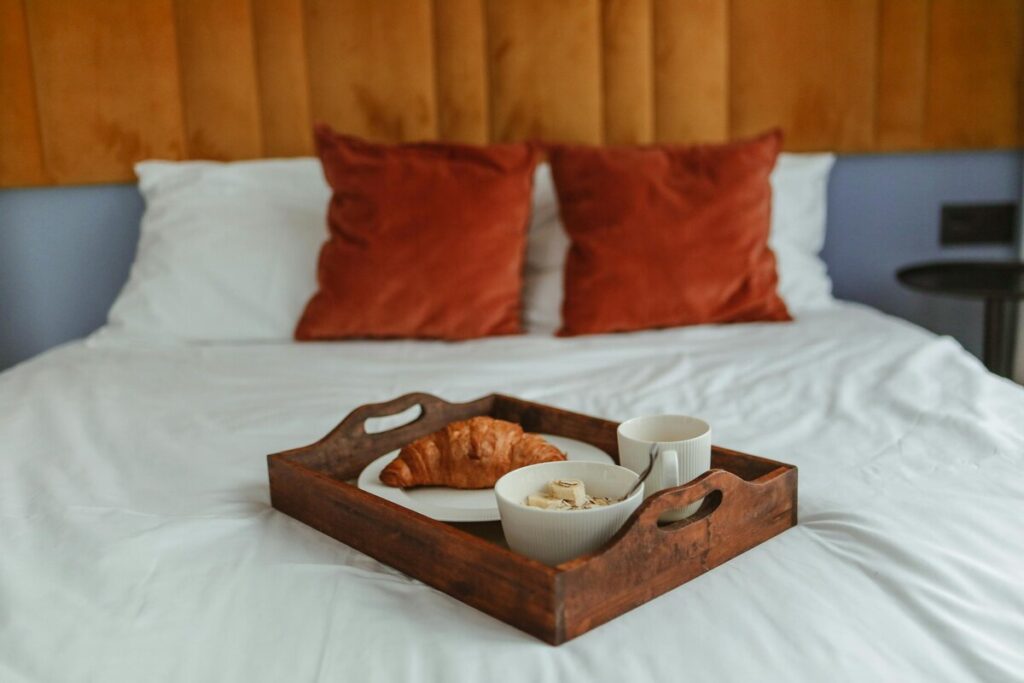
A well-run hotel room service program is one of the most visible touchpoints of your guest experience: it happens in private, it’s judged fast, and it’s easy to mention in reviews. Yet many hotels still treat it like a cost center—phone orders, manual tickets, delayed charges, and chaos during peak hours. The result is predictable: slow delivery, wrong items, billing disputes at checkout, stressed teams, and guests who simply stop ordering.
This guide explains how to modernize hotel room service so it becomes a consistent revenue stream and a differentiator. You’ll get a practical framework to manage capacity, reduce errors, protect food quality, and increase average order value—without adding complexity to your staff’s day.
Hotel room service: what it is and why it still matters
Hotel room service (often called in-room dining) includes any food, beverage, or guest-amenity delivery to the room. It can be full-service (24/7), limited hours, “express” menus, or digital ordering through QR codes, mobile web, or an app.
Why invest in it now?
- Convenience drives demand: guests order because it’s effortless, especially after travel or late arrivals.
- It supports premium positioning: “we take care of everything” is a powerful promise.
- It’s a natural upsell channel: breakfast, kids’ packs, minibar bundles, late checkout snacks, romantic packages.
- It influences reviews: speed and accuracy are memorable (positively and negatively).
More about: Hotel guest types: how to serve and upsell every modern guest
The hotel room service operating model
Think of room service as a chain. Any weak link creates complaints.
1) Ordering
Goal: capture the right order with zero ambiguity.
Best practice:
- Use a structured digital menu (allergens, modifiers, room number, delivery time).
- If you still take phone orders, standardize a script and confirm key details.
2) Payment and posting
Goal: avoid “charge later” leaks and checkout disputes.
Best practice:
- Capture payment at the time of order when possible (card-on-file, online payment).
- If you post to the room, make sure the workflow is automatic and auditable.
3) Production
Goal: visibility and prioritization.
Best practice:
- Use a single queue (KDS/dashboard or clear printed tickets).
- Mark statuses: received → in prep → ready → out for delivery.
4) Delivery and handoff
Goal: protect quality and timing.
Best practice:
- Define delivery zones/routes and clear roles in peak times.
- Use packaging that keeps temperature and presentation stable.
- Add a “final check” for items, cutlery, condiments, and notes.
5) Feedback and recovery
Goal: fix issues before they become reviews.
Best practice:
- Proactive updates (“In prep”, “On the way”) reduce inbound calls.
- Simple recovery rule: if late or incorrect, offer a fast resolution (replacement + small goodwill item).
6) Data and optimization
Goal: turn daily orders into smarter decisions.
Best practice:
- Track demand by time slot, best sellers, cancellations, and average delivery time.
- Adjust staffing, menu, and capacity rules based on real volume.
Hotel room service during peak hours: prevent the meltdown
Peak hours are where profitability is won or lost. The key is to manage capacity like inventory.
Time-slot quotas
Set a maximum number of orders per 10–15 minute window. When a slot is full, offer the next available time.
Item limits per order
Limit the number of “kitchen-heavy” items per order during peaks (or limit total items). This protects throughput.
Scheduled delivery vs “as soon as possible”
Let guests choose:
- Deliver now (with an honest ETA)
- Schedule for later (helps you smooth demand)
Peak menus
Offer a simplified peak menu with items that travel well and are fast to produce. Keep your full menu for off-peak.
Common hotel room service problems and fixes
Problem: wrong orders and missing items
Fix:
- Standard modifiers (no free-text chaos)
- A packing checklist (cutlery, sauces, napkins, drinks)
- One person accountable for “final check”
Problem: late delivery and guest frustration
Fix:
- Quotas + scheduled delivery
- Status updates to guests
- Clear escalation rules (when to comp fees or offer a replacement)
Problem: billing errors and disputes at checkout
Fix:
- Immediate payment or instant posting to the room
- Digital receipts and order logs
- Fewer manual handoffs between departments
Problem: staff burnout
Fix:
- Reduce phone calls with digital ordering
- One shared queue instead of scattered messages
- Short, repeatable SOPs for peaks
Menu engineering for profitable hotel room service
A room service menu should be designed for the room—not for the restaurant.
Build for travel and consistency
- Prioritize items that hold temperature and texture.
- Reduce fragile plating and “last-minute” components.
- Offer two tiers: comfort classics + signature items.
Use smart pricing and bundles
- Bundle breakfast for two, family movie-night kits, “arrival hunger” combos.
- Consider a service/delivery fee that reflects true costs, but keep it transparent.
Make upsells effortless
Add simple add-ons:
- Extra toppings, sides, desserts
- Sparkling water, wine pairings
- Amenities (bath kit, extra towels) bundled with food for convenience
Metrics that tell you if hotel room service is working
Track a small set of KPIs consistently:
| KPI | What “good” looks like | Why it matters |
|---|---|---|
| Average delivery time | Stable and predictable | Drives satisfaction |
| Order accuracy rate | Trending up | Prevents refunds & complaints |
| Average order value (AOV) | Growing via add-ons | Improves margins |
| Orders per occupied room | Increasing | Shows adoption |
| Cost per order | Decreasing | Protects profitability |
| Review mentions (sentiment) | Fewer negatives | Impacts conversions |
The right tech stack for modern hotel room service
You don’t need “more tools”—you need fewer manual handoffs.
Minimum effective stack:
- Digital menu (mobile web/QR) with modifiers and allergen info
- Payment capture and/or automatic posting
- Kitchen queue (KDS or standardized tickets) with status tracking
- Guest notifications (order received / on the way)
- Reporting export (time-of-day, item performance, staffing insights)
You may also be interested in: Damage Deposit Hotel Guide: Secure Revenue and Guest Trust
Where Chekin fits: smoother in-stay upsells and payments
Room service often fails at the same place the guest journey fails: friction. Chekin helps you reduce it across the stay by giving you a digital, self-serve experience that can include paid add-ons and clear communication.
How hoteliers typically use Chekin to support in-room revenue:
- Offer in-stay upsells in one place: breakfast, parking, late checkout, experiences—and also room service vouchers or curated “in-room dining” packages.
- Collect online payments for extras to reduce front-desk queues and end-of-stay billing disputes.
- Automate guest communication so expectations are clear (what’s available, when, and how to request it).
The outcome is simple: guests buy more because it’s easy, and staff spend less time chasing details.
Read more about: Frontdesk hotel guide: 10 strategies to run smoother shifts
10-step checklist to improve hotel room service this month
- Define your peak hours and set time-slot quotas
- Introduce scheduled delivery as the default choice
- Simplify a peak menu (travel-friendly items)
- Standardize modifiers and allergen notes
- Add a packing checklist and final-check role
- Capture payment immediately or auto-post reliably
- Implement a single kitchen queue with statuses
- Send order status updates to reduce calls
- Bundle 3–5 high-margin combos and add-ons
- Review KPIs weekly and adjust one thing at a time
Conclusion
Hotel room service can be a powerful differentiator when it’s designed like a system: controlled capacity, clear workflows, reliable payments, and a menu built for delivery. Start by fixing peak-hour chaos, then use data to optimize staffing and menu engineering. Finally, make ordering and paying effortless—because convenience is what guests are buying.
If you want to turn in-stay services into revenue without adding workload, platforms like Chekin help you package, sell, and collect payment for add-ons (including room service offers) through a smooth digital guest journey.
Discover how Chekin can help you automate check-in, stay compliant, protect your property, and boost revenue—saving 87% of your time and earning more from every booking.
Free trial for 14 days. No credit card required!
FAQs
What’s the fastest way to improve hotel room service?
Control peak demand (time-slot quotas + scheduled delivery) and standardize order capture to reduce errors.
How can hotel room service become more profitable?
Use menu engineering (travel-friendly items + bundles), increase add-ons, and track cost per order to adjust pricing and staffing.
How do I reduce complaints about delays?
Set honest ETAs, limit peak capacity, and send proactive order status updates so guests don’t need to call.