Check-in de visu in Italy: remote operations with Chekin
Managing short-term rentals across Italy often means scaling operations with fewer on-site tasks, fewer key handovers, and more consistent guest experiences. But when self check-in is involved, check-in de visu becomes a key compliance requirement—because identity verification must be tied to the guest’s physical arrival, not completed remotely days in advance.
This article explains what check-in de visu means in practice and how a QR-based workflow can help you run properties remotely while keeping arrivals smooth and guest-friendly with Chekin.
What “check-in de visu” means for vacation rentals in Italy
In operational terms, check-in de visu requires a visual confirmation that the person arriving matches their identity document, and that this happens at the moment of access (“here and now”).
For property managers using smart locks, keypads, or key boxes, the real challenge is ensuring the identity check is connected to the entry event and can be demonstrated through traceable records.
What a compliant flow should include
A solid, defensible process typically includes:
- Visual verification: confirming the face matches the ID document
- Arrival-based completion: performed at check-in time, not in advance
- Proof and traceability: records showing when verification occurred and that it’s linked to access
- Operational consistency: the same method across properties to avoid gaps
What can put you at risk
Some “easy” practices may create exposure:
- Collecting IDs in advance without verifying visually at arrival
- Letting guests complete verification remotely before reaching the property
- Lacking an auditable trail connecting verification to the access point
Check-in de visu with QR: the simplest way to anchor verification
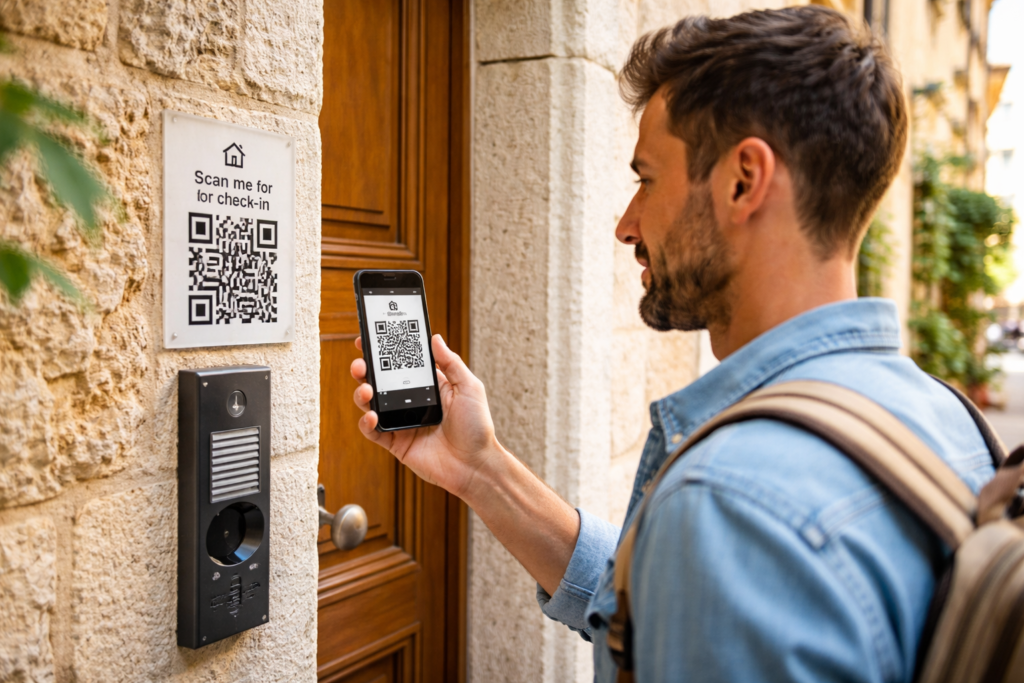
One practical way to connect identity verification to the real arrival moment is placing a QR code at the property entrance. Guests can only scan it when they are physically there, which naturally links the verification event to the access point.
How the QR workflow works (step by step)
- Place a QR code at the entrance (apartment door, building entry, or reception).
- The guest scans the QR on arrival using their phone.
- Identity verification happens at the door: document scan plus selfie/biometric checks (and liveness where applicable) to support a visual match at the right moment.
- Access instructions are released only after successful verification (code, smart lock steps, etc.).
- Reporting can be automated based on your setup (e.g., sending guest data to the relevant systems), reducing manual work.
Check-in de visu with Chekin: compliance + better guest experience
Chekin helps vacation rental managers in Italy standardize a remote-friendly operating model that keeps the check-in de visu moment connected to the entrance—while improving the guest journey.
Why this works for multi-property managers
- Remote-by-default scalability: one consistent flow across all units, even across different cities
- Less daily workload: guests complete the process themselves at arrival, reducing coordination and late-night calls
- Clear traceability: an auditable trail that helps demonstrate the moment and outcome of verification
- Fewer access issues: less dependency on staff schedules and fewer “where do I find the keys?” situations
Guest-friendly best practices (that also support compliance)
1) Put the QR where it matters
Place the QR at the entrance, not inside the apartment. This keeps the process tied to the real-world access moment.
2) Keep the instructions simple
Send one message 24–48 hours before arrival:
“On arrival, scan the QR at the entrance to verify your ID and instantly receive access instructions.”
Clear guidance reduces confusion and speeds up late check-ins.
3) Standardize signage across your portfolio
Use the same poster design, placement, and wording in every property so guests know what to expect and your team avoids inconsistent setups.
Conclusion
For Italian vacation rental managers, check-in de visu is not just a legal detail—it’s a workflow you need to operationalize across your portfolio. A QR-based entrance flow is one of the most practical ways to link identity verification to the guest’s real arrival, build traceability, and still deliver a modern, frictionless self check-in experience.
With Chekin, you can run properties remotely, standardize compliance-friendly verification, reduce daily admin, and give guests the fast arrival they expect.
Discover how Chekin can help you automate check-in, stay compliant, protect your property, and boost revenue—saving 87% of your time and earning more from every booking.
Free trial for 14 days. No credit card required!
FAQ: quick answers for managers
Do I need to be physically present for check-in de visu?
Not necessarily. A digital process can support compliance when it ensures visual identity verification at arrival and keeps traceable records linked to access.
Is collecting ID documents before arrival enough?
By itself, it may not be. The key is connecting verification to the guest’s on-site arrival and maintaining traceability.
Why is a QR at the door so effective?
Because it reduces the chance of “remote completion” and anchors verification to the real check-in moment at the access point.
Read more about:
E-Invoicing EU: A Complete Guide for Hospitality Providers