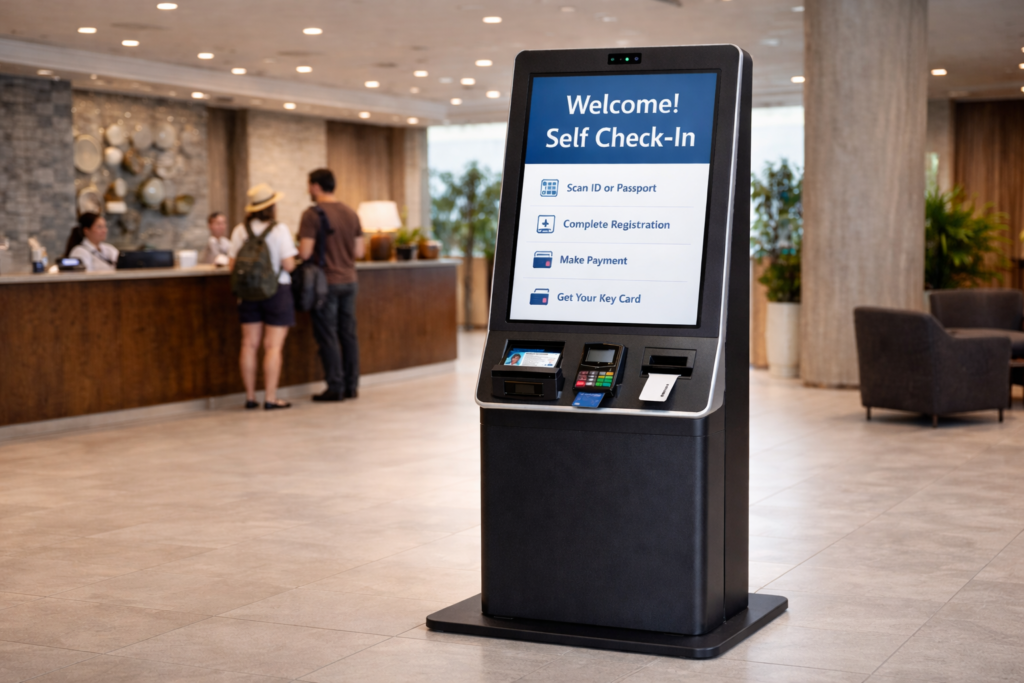
Self Check-in Kiosk for Smarter Guest Arrivals
In hospitality, first impressions are operational. A long queue at reception, a delayed late-night arrival, or a guest who still needs to complete registration can turn check-in into friction before the stay has even begun. That is why the self check-in kiosk is becoming an increasingly valuable tool for hotels, serviced apartments, aparthotels, and professional vacation rental operators.
For managers handling multiple properties or high guest volumes, the challenge is not only to check guests in faster. It is to create an arrival process that is efficient, secure, scalable, and aligned with modern guest expectations. A well-designed kiosk helps achieve exactly that. It gives guests more autonomy while giving operators more control over arrivals, payments, verification, and on-site workflows.
This is especially relevant in a market where guests expect convenience, but operators still need reliability and consistency behind the scenes. The right kiosk does not just digitize reception. It upgrades the entire arrival experience.
Why the self check-in kiosk is reshaping hospitality
The modern guest journey begins before the room. In many properties, check-in is still one of the most staff-intensive moments of the stay. It depends on availability at the desk, manual validation, repeated explanations, and too often, unnecessary waiting time.
A self check-in kiosk changes that dynamic. Instead of forcing every arrival through the same manual process, it allows guests to complete key steps independently through a guided, on-site flow. This reduces pressure on staff, shortens waiting times, and makes arrivals easier to manage during peak hours or outside standard reception schedules.
For professional operators, the benefits are practical and immediate. A kiosk can help:
- support 24/7 arrivals
- reduce front desk congestion
- lower repetitive reception workload
- standardize guest check-in across properties
- improve the guest experience from the first interaction
For vacation rental managers, it can also solve a frequent operational gap: what happens when the guest arrives without having completed the online check-in flow in advance. Instead of creating extra manual work, the process can continue smoothly on-site.
What a self check-in kiosk should actually deliver
A kiosk should do more than look modern in the lobby. To create real operational value, it needs to support the full arrival journey, not just one isolated task.
Fast and secure identity capture
Every efficient arrival starts with accurate guest information. A strong kiosk experience should allow guests to scan passports or IDs directly at the device, reducing manual data entry and limiting errors. This speeds up the process while improving data quality.
A complete hotel self check-in system
The kiosk itself is only one part of the experience. A robust hotel self check-in system connects the physical device with the workflows behind it, so the guest can move from reservation lookup to registration, payment, and final access without unnecessary staff intervention.
This is what separates a useful arrival tool from a basic digital terminal. The system must work as part of the operation, not outside it.
Payment collection without friction
A well-implemented kiosk can also collect pending balances during check-in. This is an important operational advantage for properties that want to reduce manual payment handling and avoid delays at the desk. Guests complete the process in one place, while staff can focus on more valuable interactions.
Room access or key card handoff
One of the most important features of a hotel self check-in kiosk is its ability to move guests from check-in to room access without breaking the flow. Whether that means dispensing a key card or supporting integrated access workflows, the result is the same: a smoother, more complete arrival experience.
Why a hospitality kiosk makes sense beyond hotels
For many hospitality businesses, check-in remains one of the least scalable parts of the operation. Staffing needs increase with arrival volume, but service consistency does not always improve. This is where the value of a self check-in kiosk becomes clear.
By automating the repetitive parts of arrival, operators can reduce bottlenecks and improve team efficiency. Staff no longer need to manually process every document, answer the same questions at the desk, or manage avoidable queues during peak check-in windows.
This is especially valuable for:
- hotels with high arrival traffic
- aparthotels and serviced apartments
- resorts with centralized reception
- professional vacation rental managers with large portfolios
- mixed hospitality operators looking to standardize arrivals
As the sector continues to professionalize, tools that bring structure and automation to guest arrivals are becoming more valuable, not less.
The role of the hotel lobby kiosk in guest experience
The arrival moment sets the tone for the stay. Guests notice when the process feels smooth, modern, and intuitive. They also notice when it feels slow, unclear, or overly manual. A well-executed hotel lobby kiosk helps create a stronger first impression by removing unnecessary friction from one of the most visible moments of the guest journey.
For guests, that means less waiting and more autonomy. For operators, it means a process that feels more polished and easier to manage.
A hotel lobby kiosk is particularly effective when:
- several guests arrive at the same time
- reception is handling multiple operational tasks
- the property receives late-night check-ins
- staff need to focus on service rather than repetitive admin
In other words, the kiosk improves the guest experience not by replacing hospitality, but by protecting it from operational overload.
Self check-in kiosk and compliance: where real value is created
One of the biggest weaknesses in many self-service solutions is that they focus on speed without solving the full operational reality of check-in. A process may be faster on the surface, but if staff still need to manually verify data, chase missing details, or manage disconnected systems afterward, the efficiency gain is limited.
That is why the most valuable self check-in kiosk solutions are the ones that connect arrival automation with operational workflows such as verification, registration, and compliance.
This is where Chekin brings a strong advantage. Rather than offering a stand-alone touchpoint, Chekin helps transform the kiosk into part of a broader guest management ecosystem. The result is a smarter arrival flow that supports not only convenience, but also operational control.
For hospitality managers, that means:
- fewer manual follow-up tasks
- more consistent guest data capture
- smoother arrival coordination
- a more scalable front desk model
- a stronger balance between service and efficiency
What to look for in a hotel self check-in system
Choosing the right hotel self check-in system means looking beyond the screen itself. The real question is whether the solution supports the operational model of the property.
Integration with existing workflows
A kiosk should work with the systems and processes already used by the property. Without integration, teams often end up duplicating work instead of reducing it.
A guest-friendly interface
The experience should be clear, fast, multilingual, and intuitive enough for real-world use. If the guest journey is confusing, staff will still need to intervene.
Support for real arrival scenarios
Not every guest arrives perfectly prepared. The best solutions handle late arrivals, incomplete registration, and last-minute steps without disrupting the experience.
Scalability across properties
For operators managing multiple sites, consistency matters. A kiosk solution should be easy to deploy, manage, and standardize across different assets.
Conclusion
The self check-in kiosk is becoming a strategic asset for modern hospitality businesses. For hotels, serviced apartments, aparthotels, and professional vacation rental managers, it offers a smarter way to manage arrivals, reduce front desk pressure, and deliver a faster, more autonomous guest experience.
The strongest results come from solutions that go beyond basic self-service. A powerful hotel self check-in system combines identity capture, verification, payment collection, and access workflows into one connected experience. When that process is supported by Chekin, operators also benefit from a more streamlined and scalable approach to guest management.
In a sector where efficiency and guest experience increasingly go hand in hand, the kiosk is no longer just a lobby feature. It is a practical tool for building better arrivals at scale.
Discover how Chekin can help you automate check-in, stay compliant, protect your property, and boost revenue—saving 87% of your time and earning more from every booking.
Free trial for 14 days. No credit card required!
You may also be interested in:
Olala Homes: Redefining the Guest Experience with Self Check-in Kiosks
FAQs
What is a self check-in kiosk?
A self check-in kiosk is a physical device that allows guests to complete key arrival steps on-site, such as identification, registration, payment, and access preparation.
Who benefits most from a hotel self check-in kiosk?
A hotel self check-in kiosk is especially valuable for hotels, aparthotels, serviced apartments, and large vacation rental operators handling high guest volumes or after-hours arrivals.
What does a hotel self check-in system include?
A hotel self check-in system typically includes guest registration, document scanning, verification, payment handling, and connection with operational workflows.
Is a hospitality kiosk suitable for vacation rentals?
Yes. A hospitality kiosk is highly relevant for professional vacation rental managers with centralized arrivals, larger portfolios, or hybrid accommodation models.
What is the benefit of a hotel lobby kiosk?
A hotel lobby kiosk reduces queues, improves guest autonomy, supports 24/7 arrivals, and helps front desk teams focus on service rather than repetitive admin.